
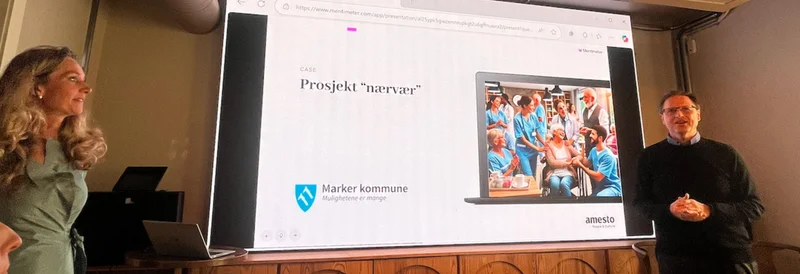
Marker kommune presented its systematic approach to reducing sickness absence, in collaboration with Amesto People and Culture. The event took place on 28 March 2025 at The Conduit in Oslo.
Incredibly exciting and educational if you were there, if not I hope this can inspire you too to reduce sickness absence in your municipality!
Background: Sick leave is a big challenge
First, Norway takes the gold medal in high sickness absence. It is a challenge for many municipalities with an average of sick leave in the second quarter of 2024 of 8.3% according to KS. This entails large costs, increased workload on healthy colleagues and potentially poorer service quality for residents.
How can municipalities reduce sickness absence in an effective and lasting way is the question Stig Arne Holtedahl, municipal director in Marker municipality asked Yvonne Fosser in Amesto People and Culture!
In this blog post, we share the 7 measures Marker municipality has introduced together with Amesto People and Culture. Experience shows that a holistic approach with broad involvement of all stakeholders produces a lasting effect.
1. Anchor a clear goal from the top
One of the most important success factors is to have a clear, anchored objective for reducing sickness absence from the top:
Example: Marker municipality set a clear target for the sickness absence work. The goal was known to everyone, from the municipal director to union representatives and employees.
Why does this work? Everything starts at the top, said municipal director Stig Arne Holtedahl several times in the presentation. When senior management clearly communicates goals and expectations, everyone knows what to aim for.
2. A comprehensive action plan
Reducing sickness absence requires an overall strategy that avoids "patchwork" solutions. Therefore involve the following actors already in the planning phase:
- Local medical group: Ask to avoid routinely long sick notes from GPs.
- NAV: Ensure quick dialogue and preferably one permanent contact person who can clarify matters quickly, and do not make employees wait long before they get an appointment.
- Trade union representatives and safety representatives: Give them insight into the plans, and listen to input on how the measures will be perceived "on the floor."
- HR and finance department: Report absence statistics and costs regularly, and show how measures affect the figures over time.
Why does this work? It creates joint ownership of the project and prevents individual departments from taking conflicting measures. When everyone pulls in the same direction, it becomes easier to achieve a lasting effect. Get the GPs, safety representatives, shop stewards and managers to move in the same direction.
3. Make sickness absence figures and costs visible to everyone
Regular reporting and visibility of results is essential to keep the focus on sickness absence:
- Simple overviews: Send an overview of sickness absence in each department to managers immediately after the payroll run.
- Discussed in management meetings: Take a few minutes at each meeting to reflect on the numbers.
- Inform employees: Show how sickness absence affects colleagues, budgets and the residents who receive services.
Why does this work? What you pay attention to, gets improvement, says Yvonne Fosser in Amesto People and Culture. When managers and employees see how sickness absence develops, they better understand the consequences and become more motivated for measures that reduce absence.
4. Strengthen the competence of managers
Good follow-up of sick employees can be the difference between short or long time away from work. However, many managers lack the knowledge required to do this correctly.
- Offer courses and guidance: About regulations, facilitation and good routines for follow-up.
- Invest in trust: Managers who show genuine concern for their employees create a better working environment.
Why does this work? When managers know how to follow up employees who are absent due to illness or struggling with health-related challenges, they can often find alternative work tasks or adaptations. This can significantly reduce the duration of sick leave.
5. Involve shop stewards, safety representatives and employees
Employee representatives can often have key knowledge about what is happening in the organisation. They play an important role in:
- Anchor measures: Make sure they feel fair and appropriate.
- Provide feedback: To management and HR about the measure's practical consequences.
- Support those on sick leave: Be a safe resource and support for colleagues who are struggling.
Why does this work? Good cooperation with shop stewards contributes to the measures gaining legitimacy among the employees. They can also "catch" any misunderstandings or problems early on. One example was that employees in a department with high sickness absence wanted higher targets than the management for reducing sickness absence. Often it is those on the front line who feel the problems the most, so don't be afraid to involve them.
6. Focus on presence, not just absence
A high level of sickness absence can be caused by many factors, but a positive approach can have an additional effect:
- Recognize employees who are at work: Encourage and thank those who attend, and show that their presence is appreciated.
- Facilitate where possible: Small adjustments in working hours, tasks or workplace can sometimes prevent long-term absences.
- Create a good working environment: The better the well-being, the less likely it is that people will get sick or want to leave.
Why does this work? "Punishing" absence can quickly be perceived as negative. A culture of presence is based on positive reinforcement, community and solutions that make it easier to return to work quickly and safely.
7. Ensure lasting effect with digital support
A common challenge is that sickness absence goes down for a period, but creeps up again when the focus decreases. To avoid this, municipalities can use digital platforms for:
- Ongoing follow-up: Automated reminders to managers and HR managers when employees are on sick leave over a certain period.
- Simple sharing of best practices: Digital learning modules and resources make it easier for both new and established managers to follow real routines.
- Continuous reporting: Statistics and overviews showing changes in sickness absence over time.
Why does this work? Marker municipality has entered into an agreement with Preppio for sickness absence, which systematises training, follow-up and reduces the risk of losing track of records. Managers save time, and it becomes easier to ensure that sick leave is properly followed up.
Summary: This is how you succeed in reducing sickness absence in municipalities
- Clear goal and anchoring in top management
- Comprehensive action plan with broad involvement (doctors, NAV, union representatives)
- Regular reporting and visibility of sickness absence and costs
- Strengthen the competence of managers for good follow-up
- Involve the employees' representatives, build trust
- Promote a culture of presence rather than "punishing" absence
- Use digital tools to keep the pressure up over time
By following these steps, municipalities can work more systematically with sickness absence. The experiences from Marker show that a holistic, transparent and inclusive approach provides the best conditions for a lasting effect.
Would you like more information on how municipalities can systematise and keep up the pressure in the work towards lower sickness absence? Contact us in Preppio here.
This article has been written to inspire municipalities and other public enterprises that want to reduce sickness absence in a sustainable way. By sharing Marker municipality's experiences, we hope to show that a holistic, transparent and inclusive approach is the key to success.
Do you have questions or input? Contact me directly at amin@preppio.com






 Microsoft Teams