
Getting from 50% adoption to 100% adoption of Workplace from Facebook is a fundamentally different challenge than the initial rollout. The first half of the organization signed up because they were early adopters or were directly engaged by the launch team. The second half requires a different playbook entirely.
Two Goals: Adoption and Engagement
It is important to distinguish between two separate objectives:
- Adoption — Getting employees to sign up and return to Workplace regularly. An adopted user is someone who logs in habitually, not someone who created an account once and never came back.
- Engagement — Getting employees to actively post, comment, react, and interact with content. Engagement is the behavior that creates value on the platform.
Both are necessary. Adoption without engagement creates a ghost town. Engagement without broad adoption limits the network's value.
4 Core Principles
Every tactic in this guide maps back to four core principles:
- Relevant content. People return to platforms that have content they care about. If Workplace is filled with corporate announcements that no one reads, adoption will stall. The content must be useful, timely, and relevant to the daily work of each employee.
- Enable connection. The primary value of Workplace is human connection. Every feature and initiative should make it easier for employees to connect with colleagues, teams, and leadership.
- Leverage influencers. Certain employees have outsized influence on their peers. Identifying and activating these individuals accelerates adoption more effectively than any top-down mandate.
- Incremental progress. Do not try to get everyone to full engagement overnight. Move people one step forward: from unaware to aware, from aware to signed up, from signed up to occasional user, from occasional to regular.
Rogers' Diffusion of Innovations
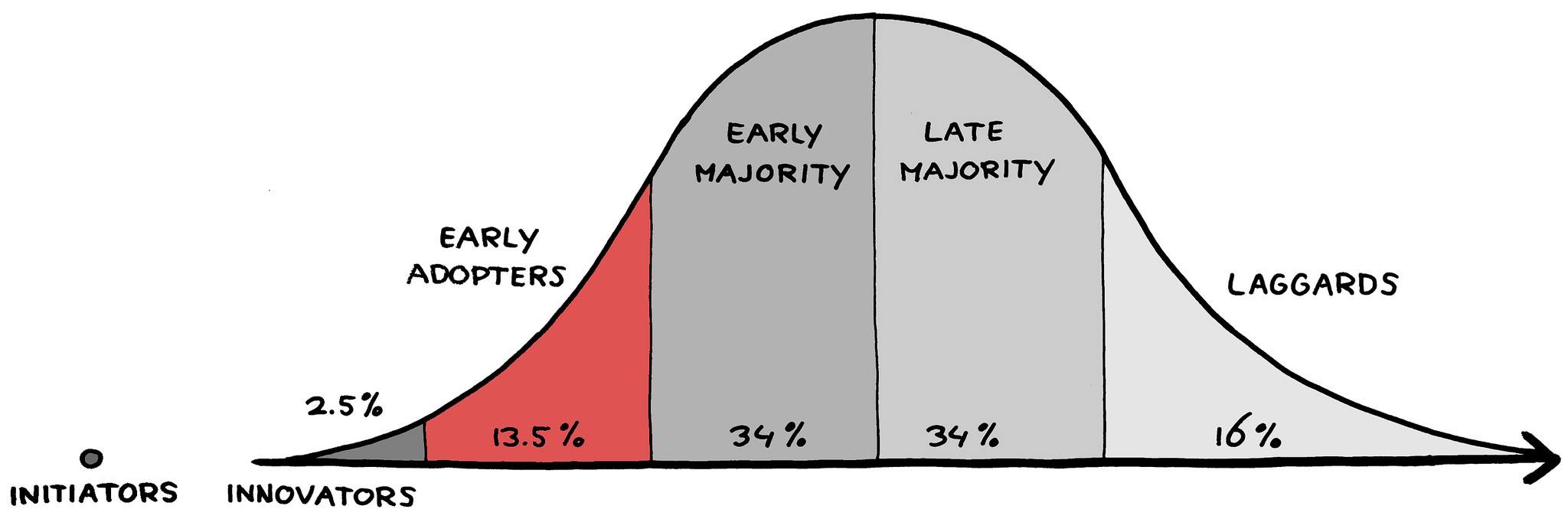
Understanding where you are on the adoption curve is essential for choosing the right strategy. Everett Rogers' diffusion of innovations model describes adoption in five segments: Innovators, Early Adopters, Early Majority, Late Majority, and Laggards.
A critical insight: the last 16% (Laggards) is just as hard as the 60%-86% journey (Late Majority). These are employees who are actively resistant to change, skeptical of new tools, or simply do not see the relevance of Workplace to their job. They require fundamentally different approaches than the early and middle groups.
Case Study: A 10,000-Employee Organization at 60%
Consider an organization with 10,000 employees that has achieved 60% Workplace adoption. That means 6,000 employees have accounts, but 4,000 do not. Of the 6,000, perhaps only 2,000-3,000 are truly active. Focus efforts on two groups:
- Group A: 200 middle managers checking in weekly
- Group B: 2,000 frontline workers rarely or never checking in
The strategy prioritizes converting the 200 managers (influencers) rather than the 2,000 frontline workers, leveraging network effects to drive cascading adoption.
The 7 User Categories
To develop targeted strategies, segment your employee base into seven categories:
- Power User — Posts frequently, creates groups, initiates discussions. These are your champions.
- Daily Active — Logs in every day, reads content, reacts and comments regularly.
- Weekly Check-in — Visits Workplace a few times per week, engages sporadically.
- Infrequent — Has an account, logs in rarely, minimal engagement.
- One-time Signup — Created an account during the initial launch but has never returned.
- Aware but Non-engaged — Knows Workplace exists but has never signed up.
- Unaware — Does not know Workplace exists or what it is for.
Each category requires a different intervention. The mistake most organizations make is applying the same broad communication to all seven groups.
The Network Effect and Its Impact on Adoption
The theoretical foundation for driving adoption is the network effect: the network's value increases according to the number of others using it. Three laws illustrate this dynamic:
- Sarnoff's Law — value proportional to network size
- Metcalfe's Law — value proportional to the square of users
- Reed's Law — clusters scale faster through influence
Each new user makes the platform more valuable for every existing user. This is why adoption becomes self-reinforcing once you cross a critical threshold -- but it also means that every non-adopter reduces the value for everyone else.
Adjacent User Theory
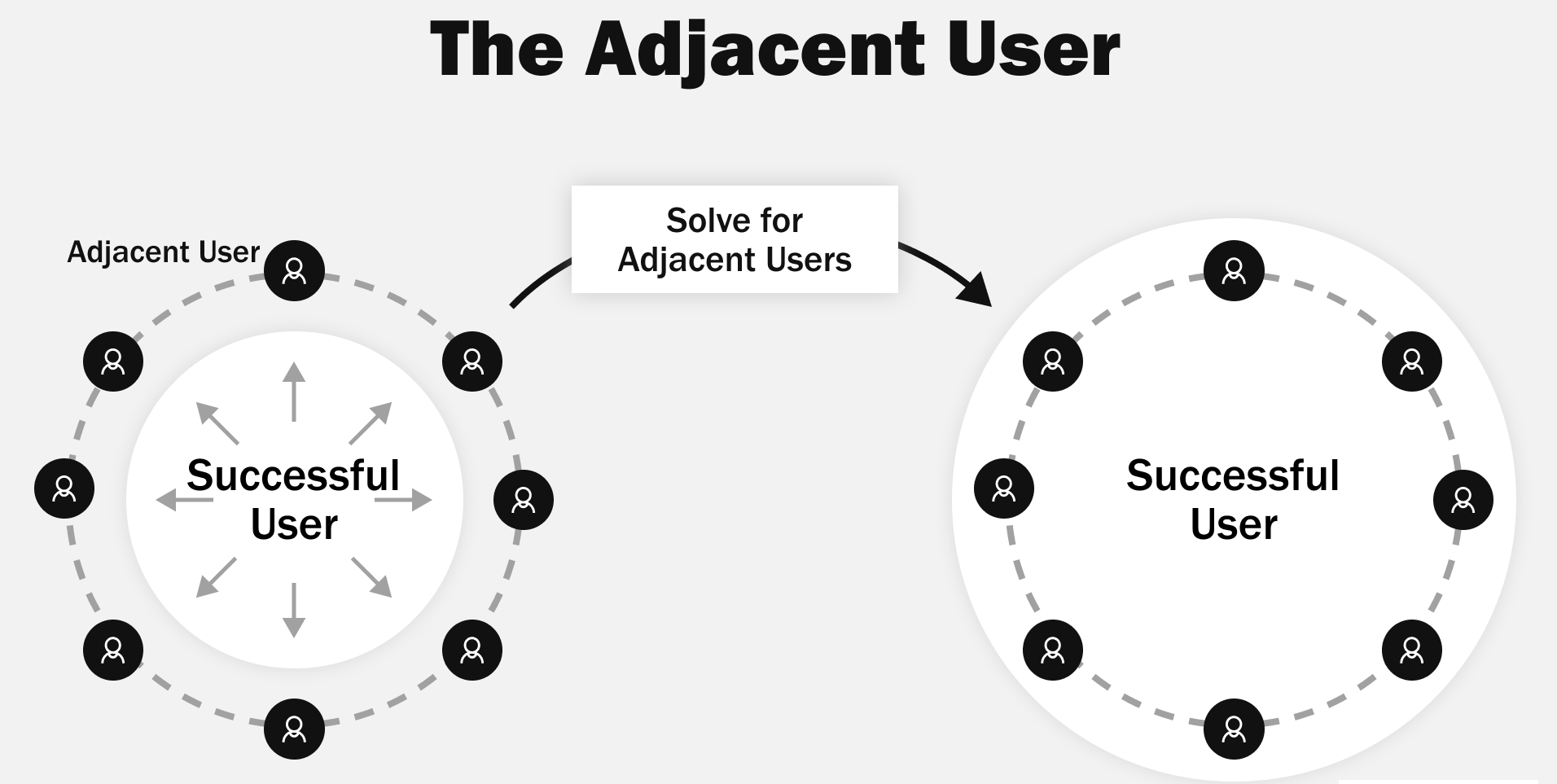
The Adjacent User Theory, popularized by growth teams at companies like Facebook and Airbnb, argues that you should focus on users who are one step away from adopting. These are not the people who will never use the platform -- they are the people who would use it if one barrier were removed. Influencers act as magnets, pulling adjacent users into the active user base through personal connection and demonstrated value.
Power transferral does not work from the bottom up. A CEO is far less likely to cease using their preferred channel and adopt WorkChat simply because a middle-tier manager has done so.
The Power of Managers
Managers are the single most powerful lever for driving adoption. Consider the math: in a 10,000-person organization, there might be approximately 200 managers, each with an average of 10 direct reports. That gives you access to 2,000 employees through just 200 conversations. If a manager uses Workplace, posts updates there, and expects their team to engage, adoption in that team approaches 100%.
Power Users as Strategic Assets
Power Users are your force multipliers. These are employees who have organically adopted Workplace and use it enthusiastically. They create content that draws others in, they model the behavior you want to see, and they provide peer-to-peer credibility that no corporate communications team can match. Identify them, support them, and give them the tools and recognition they need to keep going.
WorkChat vs. WhatsApp and Shadow IT
One of the most common barriers to Workplace adoption is the existence of competing communication channels — particularly WhatsApp groups that employees have set up informally. These shadow IT channels are a symptom of unmet needs: employees need a fast, mobile, informal way to communicate, and if the official tool does not fill that need, they will find something that does.
WorkChat is the answer, but only if it is positioned correctly. The migration from WhatsApp to WorkChat must be driven by convenience and value, not by mandate. Show employees that WorkChat does everything WhatsApp does — with the added benefit of integration with Workplace groups, searchable history, and IT oversight. Shadow IT policies should address the security risks of unofficial channels while providing a better alternative, not simply banning the tools people rely on.
Strategic Steps Forward
Driving adoption from 50% to 100% is not a single initiative — it is a sustained campaign. Start by segmenting your users, identifying your influencers and power users, activating managers, and making Workplace the path of least resistance for the communication and collaboration needs of every employee category. Measure progress weekly, celebrate wins publicly, and adjust tactics based on what the data tells you.
Need help driving adoption across your organization?
Preppio's automated messaging and engagement tools help you reach every employee segment — from power users to the unaware — with the right message at the right time.







 Microsoft Teams